Why the Best B2B Demand Generation Tactics Get Ignored
There is a pattern that repeats itself in almost every B2B Demand Generation Tactics conversation at the leadership level.
The team presents a pipeline problem. Someone suggests paid acquisition. Someone else recommends a new content strategy.
A third person mentions account-based marketing. Nobody mentions the tactics that are actually working.
The reason is not ignorance. It is selection bias built into how growth teams are structured and evaluated.
Most B2B demand generation tactics are measured by volume and velocity: how many leads entered the funnel, how fast, and at what cost. This creates a systematic preference for tactics that are easy to scale and easy to attribute, even when those tactics deliver lower-quality pipeline than alternatives that are harder to measure.
A recent discussion among growth practitioners revealed what is actually moving the needle for the teams seeing the best results.
The answers had almost nothing to do with new channels or technology. They had everything to do with fundamentals that most teams have deprioritized in favor of automation and reach.
This post breaks down those tactics, why they work, and how to apply them within a B2B demand generation strategy designed for executive decision-making and long-cycle pipeline development.
B2B Demand Generation Tactics
Why the most effective tactics keep getting skipped
B2B teams are not ignoring high-performing tactics out of ignorance. They are ignoring them because of a systematic bias built into how growth is measured and rewarded.
Bias 1
Volume over quality
Teams optimize for number of leads, not quality of pipeline. Scalable beats effective.
Bias 2
Attribution over impact
If a tactic is hard to measure directly, it gets cut. Even when it drives the best outcomes.
Bias 3
Scale over depth
Manual and human tactics are dismissed before testing because they “do not scale.”
Every pipeline review follows the same script: paid acquisition, content strategy, ABM. Nobody mentions the tactics that are actually working, because those tactics are hard to scale, slow to attribute, and require human judgment rather than automation.
How the typical pipeline conversation goes
Pipeline gap
Problem surfaces
Paid ads
First suggestion
More content
Second suggestion
Same result
Cycle repeats
What actually works instead
1
Dormant lead reactivation
2
Community presence
3
Micro-CRO on existing pages
4
Onboarding friction removal
5
Consistency as compound asset
The common thread
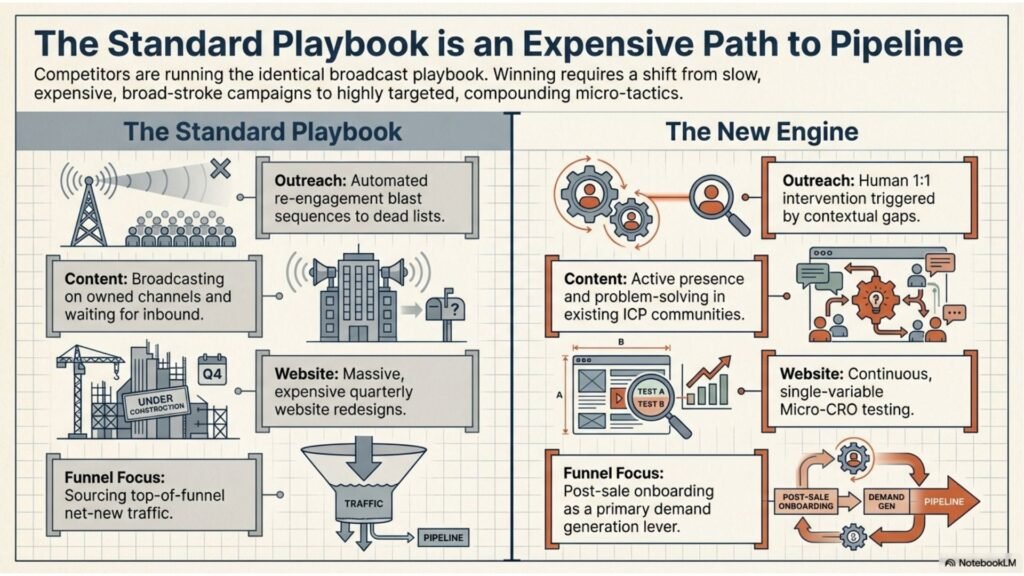
Every tactic that actually works feels too slow, too manual, or too small to matter. That is precisely why they still work when every scalable alternative has been commoditized by competitors running the same playbook.
The 5 Underrated Tactics That Practitioners Swear By
The following tactics share one characteristic: they feel too slow, too manual, or too small to matter at scale. That feeling is precisely why they still work when everything else has been commoditized.
Tactic 1: Reactivating Dormant Leads With Human Follow-Ups
Every B2B company has a database of contacts who showed intent at some point and then went quiet. Most teams treat these contacts as lost. The ones generating pipeline from them are treating them as untapped pipeline.
The approach is not a re-engagement blast sequence. It is a single, human message sent to one person at a time, referencing something specific about where they left off or what has changed since then.
One practitioner described it directly: “It is wild how many dead contacts convert when you treat them like people instead of a list.”
The mechanism is straightforward. When a prospect went cold, the timing or the message was wrong, not necessarily the interest.
A personalized follow-up that acknowledges the gap, references a relevant development (a product update, an industry shift, a trigger event at their company), and asks a single low-friction question can restart conversations that seemed permanently closed.
How to apply it at the executive level:
Identify contacts in your CRM who had three or more meaningful touchpoints, reached a qualification threshold, and have been inactive for 90 to 180 days. Assign these to a specific rep or to the marketing leader personally, with a mandate to send individualized messages at a rate of 10 to 20 per week. Track replies and meetings separately from your standard outbound metrics.
Signal-based outreach for B2B pipeline
Tactic 2: Community Presence Over Broadcast Content
The standard content marketing playbook tells B2B teams to publish consistently on owned channels and wait for inbound.
This is sound advice for long-term brand building, but it is a slow path to pipeline and an increasingly expensive one as every competitor runs the same playbook.
A more effective B2B demand generation tactic for immediate pipeline impact is showing up where your ICP is already having conversations, contributing meaningfully, and building recognition without pitching.
Practitioners who have applied this consistently report the same outcome: a single thoughtful contribution in the right community thread generated more qualified conversations than weeks of publishing on their own channels.
The key distinction is between presence and promotion.
Presence means answering a question with genuine depth, sharing a framework that solves the problem being discussed, or acknowledging a nuanced point that others missed.
Promotion means linking to your content or your product. The former builds trust. The latter builds resistance.
Communities worth prioritizing for B2B tech:
Slack communities specific to your vertical, LinkedIn posts from high-engagement accounts in your target segment, niche subreddits where practitioners discuss the problems your product solves, and industry newsletters that allow reader commentary or Q&A sections.
How to apply it at the executive level:
Identify three to five communities where your ICP is active and where genuine expertise earns recognition. Assign a team member or do this yourself for 30 minutes per day.
Track which communities generate inbound connections and conversation requests.
After 60 days, you will have a clear signal on where to concentrate effort.
B2B Demand Generation Tactics
The 5 tactics at a glance
When to use each, how long it takes, and what to measure. Use this as a decision reference before building your roadmap.
Fastest results
Dormant leads
Pipeline within 30 days, zero new budget required
Highest ROI
Micro-CRO
Improves all existing traffic without incremental spend
Longest leverage
Consistency
Compounds over 12 months into inbound self-sufficiency
Tactic 3: Micro-CRO on Pages That Already Get Traffic
Most B2B marketing teams treat conversion rate optimization as a quarterly project rather than a continuous practice. The result is a significant amount of demand generation investment driving traffic to pages that convert at rates well below their potential.
The practitioners generating the highest returns from this approach are not running large redesigns. They are making targeted, single-variable changes to the elements that most directly influence the decision to convert: the hero headline, the first sentence of body copy, the placement and wording of trust signals, and the call-to-action text and position.
Each individual change produces a small lift, typically 1 to 2 percent. Applied consistently across pages that already carry significant traffic volume, these lifts compound in a way that outperforms most new campaign investments because they improve the efficiency of traffic that is already being acquired.
One SaaS marketing practitioner made the point directly: “Small tweaks often outperform big campaigns because they remove friction instead of adding new work.”
How to apply it at the executive level:
Identify your five highest-traffic pages with conversion goals.
Google Optimize or a comparable A/B testing platform
Establish a testing cadence of one test per page per month.
Review results in a dedicated session with the team every 30 days and roll winning variants before launching the next test.
This is a B2B demand generation tactic that requires no additional budget. It requires only discipline and a testing infrastructure that most teams already have but underutilize.
Tactic 4: Eliminating Onboarding Friction to Improve Retention
Demand generation is typically scoped to the top of the funnel. This is a strategic mistake for B2B companies with long sales cycles, because the most efficient source of pipeline is existing customers and recently closed accounts.
One practitioner shared a specific result: by automating the onboarding handoff process, specifically the data transfer and introductory scheduling that happens after a sale closes, their company saw a 12 percent jump in retention rates.
The mechanism was not a product improvement. It was the elimination of administrative friction that was making new clients feel undervalued at the moment they were most attentive.
The connection to B2B demand generation tactics is direct. Higher retention rates extend customer lifetime value, reduce churn-driven CAC inflation, and generate referral pipeline that carries significantly higher close rates than inbound or outbound alternatives.
A 12 percent improvement in retention in a mid-market SaaS business can be worth more to pipeline than a significant paid acquisition investment.
How to apply it at the executive level:
Map the onboarding journey from contract signature to first value delivery. Identify every step that requires manual effort from either the client or your team. Prioritize automation or template creation for the three highest-friction steps. Measure time-to-value before and after. Track NPS at the 30-day and 90-day marks as a proxy for retention trajectory.
B2B pipeline efficiency and CAC optimization
Tactic 5: Consistency as a Compounding Demand Generation Asset {#tactic-5}
No tactic on this list generates more widespread agreement among practitioners and more widespread failure in execution.
Consistency in showing up, whether through content, community presence, or direct outreach, is the single most reliable driver of compounding brand authority in B2B markets.
The challenge is that consistency produces no visible return in the first 30 to 60 days.
This makes it indistinguishable from failure in the short term, which causes most teams to abandon it before the compounding effect has a chance to materialize.
One practitioner summarized the dynamic with unusual clarity: “As soul-suckingly exhausting as it may be, especially on LinkedIn, consistency is what actually works.”
The practitioners who sustain it over 6 to 12 months consistently report the same outcome: inbound conversations start arriving without outbound effort, because the consistent presence has built sufficient recognition and trust within the target segment that prospects begin to initiate contact themselves.
How to apply it at the executive level:
Choose one channel where your ICP is most active. Commit to a publishing or engagement cadence that is sustainable at 80 percent capacity, not maximum effort.
The cadence that gets maintained for 12 months outperforms the cadence that gets abandoned at month 3. Build accountability into the process by tying it to a quarterly review metric rather than a weekly task list.
How to Prioritize These B2B Demand Generation Tactics
Prioritization Framework
Which tactic should you start with?
Your pipeline problem determines your starting point. Use this decision tree before building your quarterly demand generation roadmap.
Start here
What is your primary pipeline problem right now?
Tactic 1
Dormant lead reactivation
Human 1:1 messages to contacts with prior intent who went quiet in the last 90-180 days
Also add
Micro-CRO
Fix conversion on pages that already have traffic while reactivation runs
Tactic 2
Community presence
Show up in niche communities where your ICP is already having conversations. Contribute, do not promote.
Tactic 4
Onboarding friction removal
Map the post-sale journey and eliminate every manual step that makes new clients feel undervalued
Tactic 5
Consistency as compound asset
Pick one channel your ICP is active in. Commit to a cadence sustainable at 80% capacity for 12 months.
Run all five in parallel as you scale
The decision tree identifies where to start based on your current constraint. A mature demand generation program runs all five simultaneously, with different owners for each lane. These are not alternatives. They are a portfolio.
Not all five tactics belong on the same roadmap at the same time. The right sequencing depends on your current pipeline situation, team capacity, and the stage of your demand generation program.
Use this framework to prioritize:
If pipeline volume is the immediate problem: Start with dormant lead reactivation (Tactic 1) and micro-CRO (Tactic 3). Both generate results within 30 to 60 days and require no new channel development or budget.
If pipeline quality is the problem: Invest in community presence (Tactic 2). This is a slower build but systematically attracts higher-intent prospects than paid acquisition or cold outreach.
If retention and expansion pipeline are underperforming: Onboarding friction elimination (Tactic 4) is the highest-leverage starting point. Fix the leaks before increasing the flow.
If you are building for the 12-month horizon: Consistency (Tactic 5) is non-negotiable. It is the foundation that makes every other tactic more effective over time because it gives your outreach, your content, and your community presence a recognized brand to land on.
A complete B2B demand generation tactics program runs all five in parallel, with different team members owning different lanes. The mistake is treating them as alternatives rather than as a portfolio.
4. What to Measure Across Each Tactic
Each tactic requires a distinct measurement framework. Using the same metrics across all five creates misleading signal and leads to premature abandonment of tactics that are working but not yet visible in the primary dashboard.
Dormant lead reactivation: Reply rate per message sent, meetings booked from reactivated contacts, pipeline value from reactivated segment versus new outbound. Target: reply rate above 15 percent signals the segment is viable.
Community presence: Inbound connection requests attributed to community activity, conversation rate from those connections, and qualitative signal from prospect references to your community contributions during sales conversations.
Micro-CRO: Conversion rate per page before and after each test, statistical significance of winning variants (minimum 95 percent confidence before rolling), and aggregate conversion lift across all tested pages quarter over quarter.
Onboarding friction elimination: Time-to-value (days from contract to first measurable outcome for the client), 30-day and 90-day NPS, and 12-month retention rate compared to pre-initiative baseline.
Consistency: Share of voice within your target community over time, inbound conversation volume as a percentage of total pipeline, and branded search volume growth as a proxy for awareness compounding.
FAQ: B2B Demand Generation Tactics for Senior Leaders
What are the most effective B2B demand generation tactics for 2025?
The most effective B2B demand generation tactics in 2025 are the ones that most teams are actively deprioritizing: personalized reactivation of dormant leads, genuine community presence in niche practitioner spaces, micro-CRO on high-traffic pages, onboarding friction elimination, and sustained consistency in a single channel. These tactics work because they have not been commoditized by automation. They require human judgment and sustained effort, which is precisely why they generate higher-quality pipeline than the tactics that are easier to scale.
How do B2B demand generation tactics differ for enterprise versus mid-market companies?
The core tactics are the same, but the execution differs significantly. Enterprise B2B demand generation requires longer nurture cycles, more stakeholder touchpoints, and a greater emphasis on trust signals such as case studies, analyst recognition, and peer references. Mid-market demand generation can move faster, with shorter sequences and more direct calls to action. Both benefit from community presence and micro-CRO, though the channels and pages targeted will differ based on where each ICP actively engages.
How long does it take for B2B demand generation tactics to generate measurable pipeline?
It depends on the tactic. Dormant lead reactivation and micro-CRO can generate measurable results within 30 to 60 days. Community presence typically requires 60 to 90 days before inbound pipeline begins to materialize. Onboarding optimization affects retention metrics visible at the 90-day mark. Consistency as a brand-building tactic compounds over 6 to 12 months. A complete B2B demand generation tactics program should be evaluated on a rolling 90-day basis, not monthly, to avoid premature abandonment of tactics that are working but have longer feedback loops.
Should B2B demand generation focus on inbound or outbound tactics?
The most effective B2B demand generation programs integrate both, but the balance depends on the stage of your pipeline. Outbound tactics such as reactivating dormant leads and signal-based outreach deliver faster results when pipeline is thin. Inbound tactics such as community presence, content consistency, and micro-CRO compound over time and reduce CAC as the program matures. The mistake is treating inbound and outbound as competing philosophies rather than complementary tools with different time horizons.
What is the ROI of micro-CRO compared to paid acquisition in B2B demand generation?
Micro-CRO consistently outperforms paid acquisition on a cost-per-conversion basis because it improves the efficiency of traffic that is already being acquired rather than paying for new traffic. A 2 percent lift on a page converting 500 qualified visits per month at a 3 percent baseline rate generates 10 additional conversions per month without any incremental media spend. The same 10 conversions from paid acquisition at a typical B2B CPL carries a significant ongoing cost. Micro-CRO is a one-time effort that compounds. Paid acquisition requires continuous investment to maintain results.
How do you build a B2B demand generation team around these tactics?
Each of the five tactics maps to a distinct ownership model. Dormant lead reactivation is most effective when owned by a senior sales or marketing leader who can write genuinely human messages, not a junior SDR following a script. Community presence requires someone with genuine expertise in the domain, not a social media manager. Micro-CRO requires a dedicated analyst with A/B testing proficiency. Onboarding optimization requires collaboration between marketing, customer success, and product. Consistency requires an editorial owner with authority to publish without a lengthy approval chain. Build the team around ownership, not headcount.
Key Takeaways
The practitioners generating the strongest B2B pipeline are not discovering new channels.
They are doing the things that most teams consider too slow, too manual, or too difficult to attribute.
The five B2B demand generation tactics that consistently outperform their alternatives share a common characteristic: they treat the prospect or customer as an individual with a specific situation, not as a segment to be reached at scale.
Reactivating dormant leads requires a human message. Community presence requires genuine expertise. Micro-CRO requires attention to what specific visitors are experiencing. Onboarding optimization requires empathy for the new customer’s first weeks.
Consistency requires a long-term commitment that most organizations are unwilling to sustain past the point where short-term pressure escalates.
The companies that build these practices into their demand generation programs systematically outperform competitors who are still optimizing the same paid acquisition and content funnels as everyone else.