The Channel-First Trap That Breaks B2B SaaS Growth Strategy
There is a meeting that happens in almost every B2B SaaS company. Pipeline is soft. Leadership is applying pressure. Someone pulls up a slide with channel options: paid search, LinkedIn Ads, outbound SDR sequences, content, partnerships. The conversation becomes a debate about which channel to prioritize and how much to spend.
This meeting is the problem.
Not because the channels are wrong. Because the sequence is wrong.
B2B SaaS Growth Strategy
The channel-first trap that breaks B2B SaaS growth
Most B2B SaaS teams start the growth conversation with channel selection. That is the last decision, not the first. Starting there is what makes CAC spiral and demand generation fail to compound.
Symptom 1
CAC spirals
Acquisition costs keep climbing despite competent channel execution
Symptom 2
Meetings do not close
Demos book fine but cannot articulate differentiation from six other tools
Symptom 3
90-day churn spikes
New accounts churn before generating ROI, inflating true CAC further
These are not channel execution failures. They are foundational layer failures being expressed in channel metrics. The symptoms always point to a layer below execution. Investing in more channels before fixing those layers amplifies every existing problem at scale.
How the broken growth meeting plays out every time
Pipeline gap
Problem surfaces in review
Channel debate
Paid, outbound or content?
Budget approved
Channel investment begins
Same result
Foundations unchanged
The principle most teams ignore
Channels amplify what is already working. Or they amplify what is broken, at scale. Channel selection is the last decision in a sound growth strategy, not the starting point.
The four foundations that must come first
Last decision
Channel strategy and unit economics
Layer 1
ICP and problem urgency
Layer 2
Positioning clarity
Layer 3
PMF evidence
Layer 4
GTM motion and pricing
Channel selection is the last decision in a sound B2B SaaS growth strategy, not the starting point. Treating it as the starting point is the single most reliable way to make CAC spiral, demand generation fail to compound, and pipeline meetings produce no decisions.
The logic behind this was formalized decades ago by Bryan and Jeffrey Eisenberg in their conversion optimization pyramid.
Their hierarchy — Functional, Accessible, Usable, Intuitive, Persuasive — established a simple and consistently ignored principle: you cannot persuade someone through a broken experience. Persuasion is the top floor. You cannot reach it by skipping the floors below.
The same dependency logic applies directly to B2B SaaS growth strategy. Channels sit at the top.
Everything below them must be structurally sound before channel investment makes sense. When it is not, channels do exactly one thing: they amplify what is already broken, at scale.
One practitioner described a campaign that captures this pattern precisely. His team ran a three-month SDR effort targeting “B2B companies that want more leads.”
They booked meetings. But half the prospects did not match their actual use case, and the other half ghosted after demo because the team could not articulate what made them different from the six other tools those buyers had seen that week.
The issue was not the outbound channel. The issue was that the company had not done the foundational work that makes outbound coherent.
The Four Layers You Must Fix Before Touching Channels
The Eisenberg pyramid maps to B2B SaaS growth in a way that is precise enough to be diagnostic. Each layer has a direct parallel to a foundational growth decision. And each layer must be solid before the one above it can function.
B2B SaaS Growth Strategy Framework
Fix these 4 layers before touching channels
The Eisenberg pyramid applied to B2B SaaS growth. Each layer must be solid before the one above it can function. Channels sit at the top because they are amplifiers, not foundations.
Foundation
ICP and problem urgency
Diagnostic question
Could someone outside your company identify a qualifying prospect from a LinkedIn profile in under 30 seconds?
If no: no foundation exists yetLayer 2
Positioning clarity
Diagnostic question
Can your best customers explain in their own words why they chose you over the specific alternative they used before?
If no: quality traffic bouncesLayer 3
PMF evidence
Diagnostic question
Do retention curves flatten at a meaningful level and do organic referrals appear without prompting or incentive?
If no: leaky bucket, CAC climbsLayer 4
GTM motion and pricing
Diagnostic question
Does your GTM motion match your ACV and buying committee? Does pricing map to how buyers justify value internally?
If no: friction no channel overcomesLast decision
Channel strategy
Only ask this when layers 1 to 4 are solid
Which channels give the highest-fidelity access to our validated ICP at a unit economics target we can sustain?
If layers below are weak: amplifies what is brokenThe diagnostic rule: if any answer across the four layers is uncertain, the channel conversation is premature. An uncertain answer is not a qualified yes. Channels amplify what is already working, or they amplify what is broken, at scale.
Layer 1: ICP and Problem Urgency {#layer-1}
The base of the pyramid is the question that precedes everything else in a credible B2B SaaS growth strategy: does the problem you are solving feel urgent and important to a specific, narrow buyer?
Not important in theory. Not important to a broad category of companies. Urgent and important to a buyer who would notice the problem immediately if your product disappeared tomorrow.
ICP clarity is not a marketing asset. It is the structural foundation of the entire growth system. Without it, positioning cannot be written.
Without positioning, messaging cannot be validated. Without validated messaging, channel investment produces random results regardless of budget or execution quality.
The test is specificity. A functional ICP definition includes the buyer’s role, the company’s stage and segment, the specific trigger that makes the problem urgent for them right now, and the alternative they are currently using to manage the problem. If any of those elements are uncertain, the foundation is not solid.
The diagnostic question: is your ICP narrow enough that someone outside your company could identify a qualifying prospect from a LinkedIn profile in under 30 seconds?
how ICP clarity affects LinkedIn outreach response rates
Layer 2: Positioning Clarity
Once ICP is defined, the second layer of a sound B2B SaaS growth strategy asks a different but equally critical question: can the right buyer immediately recognize that your product is built for them, against a real alternative?
Positioning is not a tagline. It is the answer to a specific buyer question that every prospect asks within seconds of encountering your product: “Is this for someone like me, and is it better than what I am already doing?”
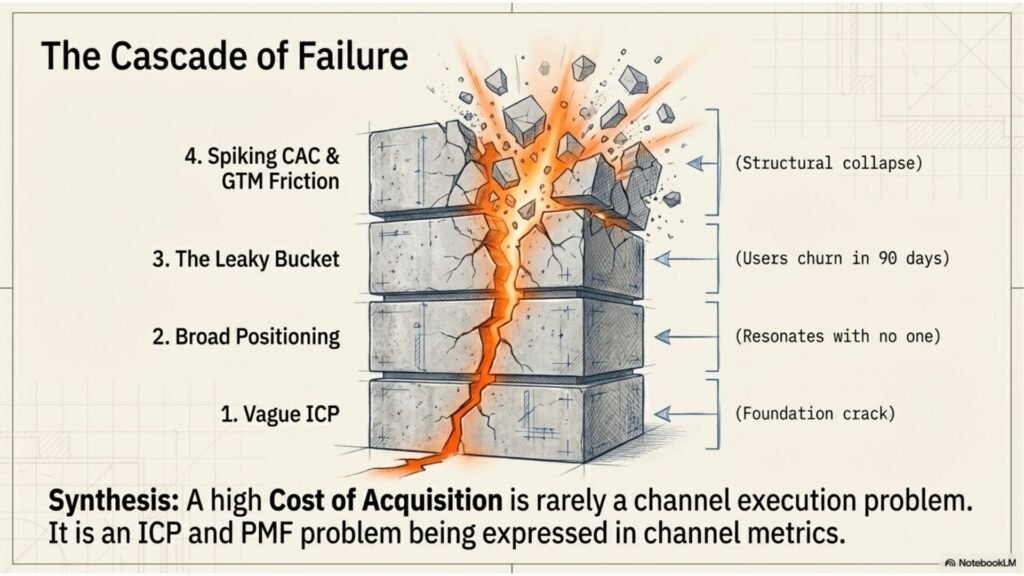
The most common positioning failure in B2B SaaS is not being wrong about differentiation. It is being too broad.
Messaging that tries to speak to every possible use case ends up resonating with none of them.
The practitioner who discovered his real edge was not “more leads” but “helping sales teams who hated cold calling to use video messages” did not change his product. He changed the specificity of his positioning.
And meeting quality changed immediately.
Positioning failure shows up in predictable symptoms: high traffic but poor conversion, meetings that do not match the use case, demos that convert at low rates because the buyer cannot articulate why your product is different from what they already have.
The diagnostic question: can your best customer, in their own words, explain who your product is for and what makes it better than the alternative they were using before?
Layer 3: PMF Evidence
The third layer in a B2B SaaS growth strategy is the one most commonly skipped when pipeline pressure builds. PMF evidence is not a feeling. It is not early traction. It is a measurable signal that a specific segment of users finds your product valuable enough to stay and tell others.
The two clearest signals are retention curves and organic referrals. Do cohort retention curves flatten at a meaningful level rather than declining toward zero?
Do users refer others without being prompted or incentivized? If neither signal is present, the product is a leaky bucket. Investing in channel strategy at this stage means spending to acquire users who will not stay, which inflates CAC, distorts unit economics, and makes every subsequent growth decision harder to interpret.
One practitioner made the diagnosis plainly:
“Most teams I have seen skip the PMF evidence layer. They push channels while retention is still weak, so CAC just keeps climbing.”
The mechanism is straightforward.
Without retention, every new user acquired through channel investment becomes a churn event within 90 days. The 90-day churn spike is not a channel problem. It is a PMF problem being expressed in channel metrics.
The diagnostic question: do you have retention curves that hold, or signals you are calling PMF because they are encouraging but not conclusive?
Andreessen Horowitz on the only thing that matters for SaaS growth
Layer 4: GTM Motion and Pricing Alignment
The fourth layer addresses the operational translation of your B2B SaaS growth strategy: does your go-to-market motion match how buyers actually make decisions, and does your pricing reflect how they experience and recognize value?
GTM misalignment produces friction that no channel can overcome. A product sold through a high-touch enterprise motion to a buyer who makes a 15-minute self-serve decision will never convert at an efficient CAC regardless of how well-targeted the demand generation is.
A product priced on a metric that does not correspond to how buyers recognize value will create objections at every stage of the funnel that the sales team will learn to work around rather than solve.
Pricing in particular is under-diagnosed as a growth constraint.
The question is not whether your price is competitive. It is whether the pricing model signals value in a way that aligns with how the buyer experiences it.
Misalignment here creates a specific kind of friction: the buyer understands the product but cannot justify the purchase internally, because the value metric does not map to a number they can defend to their CFO.
The diagnostic question: does your GTM motion match your average contract value and the size of the buying committee involved in the decision?
B2B demand generation tactics that work at each GTM stage
When the Channel Conversation Is Actually Ready to Happen
Pre-Planning Diagnostic
Run this before every channel planning meeting
Answer each question honestly. An uncertain answer is not a qualified yes. Mark your current status and see whether the channel conversation is premature.
Is our ICP narrow enough?
Is our positioning clear against a real alternative?
Do we have PMF evidence, or signals we are calling PMF?
Does our GTM motion match our ACV and buying committee?
Complete the diagnostic above
Answer all four questions to see whether your team is ready for the channel planning conversation.
Channels belong at the top of the pyramid because they are amplifiers, not foundations. The principle is simple and almost universally ignored in growth planning meetings: channels amplify what is already working. Or they amplify what is broken, at scale.
A B2B SaaS growth strategy that has solid ICP definition, validated positioning, PMF evidence, and a GTM motion that matches buyer behavior will see channels compound over time. Each acquisition makes the next one cheaper because referral loops strengthen, content compounds, and brand recognition reduces friction at every stage of the funnel.
The same strategy without those foundations will see channels degrade over time. CAC increases because the acquisition is efficient but the conversion is not. Meetings are booked but do not close because the positioning is not differentiated enough.
Churn spikes because the PMF was not genuinely present for the segment being acquired.
The channel conversation is ready to happen when you can answer yes to all four diagnostic questions from the layers below. Not mostly yes. Not yes with caveats. An uncertain answer at any layer means the foundation is not solid enough to support the investment being considered.
This is also the moment where channel selection becomes a productive conversation.
Once the foundation is in place, the question shifts from “which channels should we try?” to “which channels give the highest-fidelity access to our validated ICP at a unit economics target we can sustain?” That is a much more specific and answerable question.
The Pre-Planning Diagnostic: Four Questions Before Every Growth Meeting
Before the next channel planning meeting, the leadership team should run a four-question diagnostic from the foundation up. Each question maps directly to one of the four layers.
Is our ICP narrow enough?
The bar is not whether you have an ICP document. It is whether anyone in the room could identify a qualifying prospect from a public profile in under 30 seconds. If the answer requires qualifiers, the ICP is not narrow enough.
Is our positioning clear against a real alternative?
The bar is not whether your website has a clear value proposition.
It is whether your best customers can articulate in their own words why they chose you over the specific alternative they were using before. If they describe you in category terms rather than differentiation terms, the positioning is not doing its job.
Do we have PMF evidence, or signals we are calling PMF?
The bar is retention curves that flatten and organic referrals that appear without prompting or incentive. Early traction, investor interest, or a handful of enthusiastic customers do not constitute PMF evidence at a level that justifies channel investment.
Does our GTM motion match our ACV and buying committee?
The bar is not whether the motion is working at some level. It is whether the cost structure of the motion is sustainable at the target CAC, given the size of the contract and the number of stakeholders involved in the decision.
If any answer is uncertain, the channel conversation is premature. Investing in channels before these questions are resolved does not accelerate growth. It accelerates the rate at which the underlying problems become visible in pipeline metrics.
What to Measure at Each Layer
Each layer of the B2B SaaS growth strategy framework requires its own measurement approach. Using pipeline and CAC metrics to evaluate foundational layer health produces misleading signal because those metrics are downstream effects, not leading indicators of the problem.
ICP and problem urgency: Win rate by segment and role. If win rate varies significantly across segments, the ICP definition is not tight enough. Track which buyer profiles produce the shortest sales cycles and highest close rates. That cluster is your functional ICP.
Positioning clarity: Demo-to-close rate and the frequency of “how are you different from X?” objections in sales conversations. A high frequency of that objection signals that positioning is not differentiating effectively at the point of evaluation.
PMF evidence: 90-day cohort retention rate and the percentage of new accounts originating from referral or organic word-of-mouth. Target benchmarks vary by segment but a retention curve that does not flatten above 40 percent at 90 days is a clear signal that PMF is not present for that cohort.
GTM motion and pricing: Sales cycle length versus ACV, and the frequency of pricing objections that require executive escalation. Pricing objections that escalate routinely signal a disconnect between the pricing model and how the buyer’s internal stakeholders recognize and justify value.
OpenView’s SaaS benchmarks for retention and CAC by segment
FAQ: B2B SaaS Growth Strategy for Senior Leaders
What are the most important foundations of a B2B SaaS growth strategy before investing in channels?
The four foundational layers of a sound B2B SaaS growth strategy, in order from base to top, are ICP and problem urgency, positioning clarity, PMF evidence, and GTM motion and pricing alignment. Each layer must be solid before the one above it can function. Channel investment sits above all four. Investing in channels before these foundations are established amplifies existing problems at scale rather than generating compounding returns.
How do you know when your B2B SaaS company is ready to scale channel investment?
A B2B SaaS company is ready to scale channel investment when it can answer yes, without qualification, to four questions: is the ICP narrow enough to identify a qualifying prospect from a public profile in 30 seconds, is positioning differentiated against a specific alternative in the buyer’s own words, are retention curves flattening and organic referrals appearing without prompting, and does the GTM motion match the contract value and buying committee size. Uncertainty at any layer means the foundation is not ready to support scaled channel investment.
Why does CAC keep increasing even when a B2B SaaS team is executing well on channels?
Escalating CAC despite competent channel execution is almost always a signal of a foundational problem in the layer below channel strategy. The most common cause is weak PMF evidence: the team is acquiring users efficiently but retaining them poorly, which forces continuous reinvestment in acquisition to replace churned accounts. The second most common cause is positioning that is not differentiated enough, which creates longer sales cycles and lower close rates that inflate the cost per closed deal even when lead volume is healthy.
What is the biggest mistake B2B SaaS companies make in their growth strategy?
The most common and costly mistake in B2B SaaS growth strategy is treating channel selection as the starting point rather than the final decision. This produces a predictable failure pattern: the team invests in paid search, outbound sequences, or paid social before ICP, positioning, and PMF are validated. The channels generate activity but not compounding returns, because every inefficiency in the foundational layers is being amplified rather than eliminated. The result is unsustainable CAC, poor meeting quality, and 90-day churn spikes that are diagnosed as execution failures rather than the foundational problems they actually are.
How should a B2B SaaS leadership team run a growth strategy diagnostic?
Before any channel planning meeting, the leadership team should answer four questions in sequence, one per foundational layer. Is the ICP narrow enough to identify a qualifying prospect from a public profile in under 30 seconds? Can the best customers articulate in their own words why they chose the product over the specific alternative they were using before? Do retention curves flatten and organic referrals appear without incentive? Does the go-to-market motion match the average contract value and buying committee size? If any answer is uncertain, the channel conversation is premature and the diagnostic has identified where to focus.
How does positioning affect B2B SaaS growth strategy and CAC?
Positioning affects B2B SaaS growth strategy at every stage of the funnel. Weak positioning increases CAC by extending sales cycles, increasing the frequency of “how are you different from X?” objections, and reducing demo-to-close rates. It also increases post-sale churn because buyers who could not clearly articulate differentiation at the point of purchase are more likely to re-evaluate competitors at renewal. Strong positioning that names a specific alternative and explains the differentiation in the buyer’s own value language reduces friction at every stage and produces compounding improvements in conversion rates that no channel optimization can replicate.
Key Takeaways
The core insight of this B2B SaaS growth strategy framework is both simple and consistently ignored in growth planning conversations: channel selection is the last decision, not the first.
The Eisenberg pyramid applied to B2B SaaS reveals that channels occupy the top floor. ICP clarity, positioning, PMF evidence, and GTM alignment are the floors below.
You cannot reach the top floor by skipping the ones beneath it. And if you try, the channel investment does not fail quietly. It amplifies the foundational weakness at whatever scale the budget allows.
The companies that build compounding B2B SaaS growth strategies are not the ones that find better channels.
They are the ones that do the foundational work that makes channels compound over time: a validated ICP that makes targeting precise, positioning that makes differentiation clear, PMF evidence that makes retention durable, and a GTM motion that matches how buyers actually decide.
Channels, in that context, are not the growth driver. They are the amplifier of growth that is already structurally present.